
At Urban Green Consultants, we’re often asked to solve design challenges that go beyond the certification scope. One of our recent projects in Abidjan, Côte d’Ivoire, is a good example.
In many hotel or serviced apartment developments, individual rooms often require mechanical cooling and dehumidification to maintain high indoor air quality and meet the varied comfort needs of different guests. In hot and humid climates, the challenge is even greater; small temperature differences and consistently high humidity make wind driven and stack ventilation less independently reliable as a strategy especially when there is limited direct access to prevailing winds. Still, passive features like atria remain valuable: they bring in daylight, enhance spatial quality and when carefully integrated, can support controlled natural airflow. By pairing these passive elements with efficient mechanical systems, it becomes possible to reduce energy demand while still delivering the level of comfort and performance expected in modern hospitality spaces.
We recommended a hybrid ventilation system. That means using the atrium to bring in daylight and support natural airflow when conditions are favourable but backing it up with efficient mechanical systems that guarantee comfort year-round.
In practice, this means combining several strategies into one cohesive system. Controlled natural ventilation can be introduced through shaded, filtered inlets and operable roof vents, allowing fresh air to move through the building when conditions are favourable. Mechanical ventilation with energy recovery ensures that air entering the building is already cool and dry, reducing energy waste while maintaining comfort. Smart zoning allows cooling to be provided only where it’s needed, avoiding unnecessary energy use in unoccupied spaces. A high-performance building envelope with insulated walls and roof, solar-control glazing and ventilated cladding further reduces the cooling demand before it even reaches the system. In this way, the atrium becomes more than just a design feature; it works as a daylight engine, a support for ventilation and a space that improves orientation and overall user experience.
We looked to other buildings in hot and humid climates and the lessons were clear. The Energy Commission Headquarters in Putrajaya, famously known as the Diamond Building, was designed around the solar path of equatorial Malaysia. Its tilted façades self-shade the north and south exposures, while low-e glazing, reflective finishes and automated blinds ensure daylight can penetrate deep into the central atrium without glare or excess heat. Beyond passive strategies, the building integrates advanced mechanical systems: radiant slab cooling, dehumidified fresh air supplied through efficient air-handling units and daylight-responsive lighting controls. This combination of smart form, passive shading and efficient mechanical systems allows the Diamond Building to achieve high occupant comfort and significant energy savings in a challenging hot-humid climate. It stands as a benchmark for how hybrid design can balance daylight, ventilation and thermal comfort in complex office buildings.
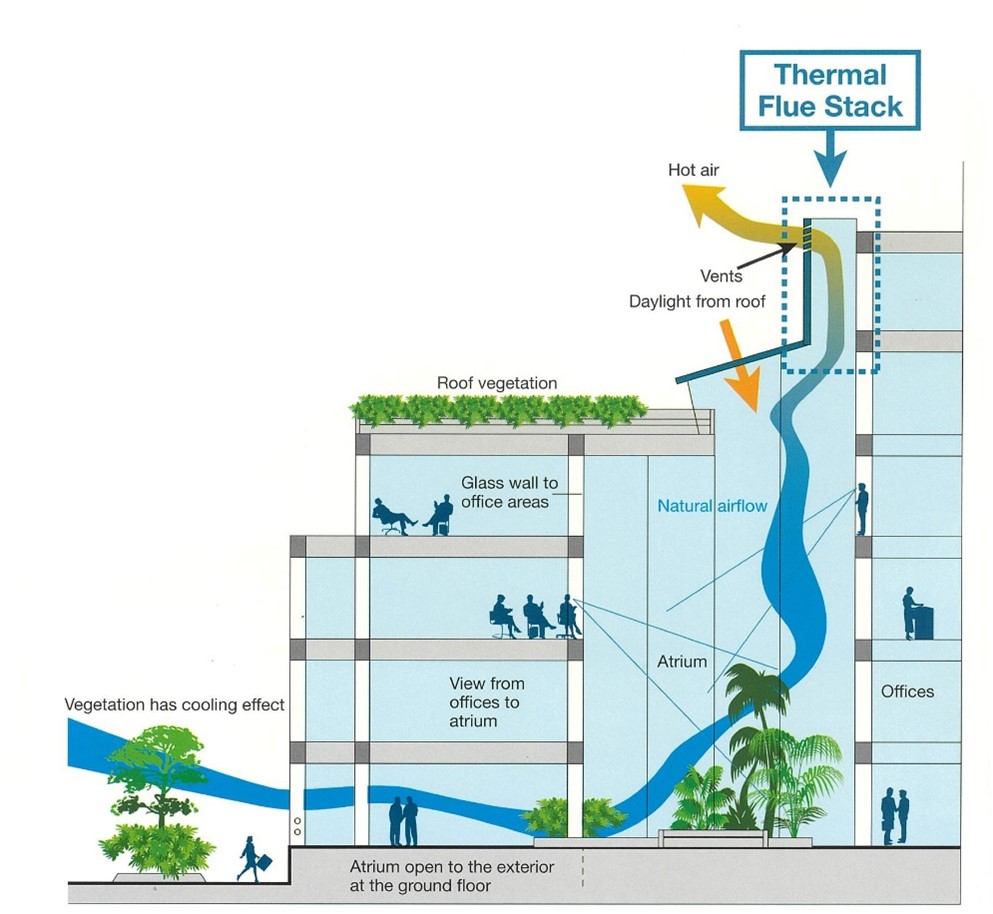
The Low Energy Office (LEO) Building in Putrajaya, Malaysia’s first full-scale green office showcase, demonstrates how mechanical and natural strategies can complement each other. Its atrium was designed for natural ventilation, supported by evaporative cooling through landscaped water features and a thermal flue. But this passive system is paired with efficient mechanical solutions integrated shading, insulation, light shelves, an advanced energy management system and connection to district cooling. Together, these measures cut energy use by 55% compared to conventional offices, with the added cost of efficiency paid back in about five years. The LEO Building proves that in hot and humid climates, low energy performance can be achieved by smartly combining natural systems with mechanical assistance.
At UGC, this is what we mean by green building advisory. It’s about finding solutions that respect the climate, meet the client’s ambitions and set a foundation for buildings that perform well for decades to come. We’re taking these lessons and shaping a design that’s resilient, efficient and future-ready. The atrium will do what it does best; deliver daylight and create a central, breathable space, while mechanical systems ensure reliable consistent comfort.
Source of image: Low Energy Office (LEO) Building, Putrajaya. Source: IEN Consultants / SNO Architects. (n.d.). Retrieved from IEN website.

Leave a comment