

Across projects, there is consistent pressure to reduce costs at design stage, a standard part of the cost balancing process. Naturally, some systems are scaled back and others removed entirely. These decisions are often necessary. But what tends to not be clear early enough is what those decisions mean over time.
When certain efficiency measures are not implemented, the costs are incurred later in how the building performs and how much it costs to run every month.
Looking at this from a practical standpoint in projects UGC Africa has worked on, we take a more structured and informed approach to efficiency and we translate it into actual operating costs.
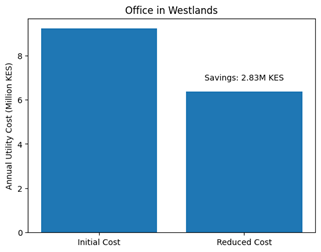
One office building in Westlands, Nairobi, is a good example. It’s a typical commercial office, about 12,000 square metres, with parking, kitchen facilities and standard support spaces. Nothing unusual in terms of use. What was done differently was how the efficiency measures were approached early in the design. The building incorporates insulation to the roof and external walls, efficient glazing, efficient lighting and on-site solar PV amongst other measures. On the water side, it uses well-selected flush and flow rates across bathrooms and kitchen areas.
The building saves approximately KES 2.83 million every year in utility costs achieving about 21% energy savings and 35% water savings.
On paper, those percentages are useful, but what matters more is what they mean. That is money that would otherwise be spent on electricity, water and other maintenance fees every single year. Over a 10-year period, that’s close to KES 28 million. And that’s before factoring fluctuation in costs, which are very likely in the Africa context.
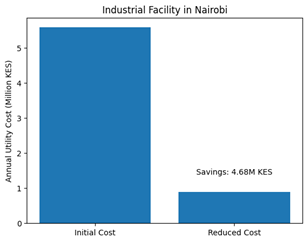
There’s another project, this time an industrial facility in Nairobi, which makes the point even more clearly. This one includes a mix of office space, storage, cold storage areas and operational zones. The approach here was more aggressive on energy, particularly because of the nature of the operations.
The building integrates insulation across the roof, walls and slab, efficient glazing and lighting, a properly treated cold storage envelope and a significant solar PV system covering about 81% of its annual energy use. Water efficiency is handled through controlled fixture specifications.
The result is extremely low operating demand relative to its size. In terms of costs, the project is saving about KES 4.68 million per year in utilities.
Over 10 years, that is roughly KES 46 million in avoided operating costs.
Again, this is not theoretical. It is based on how the building is performing. What these examples show quite clearly is that efficiency is not just about achieving a percentage target. It’s about shaping the long-term cost profile of a building.
The measures that lead to these savings come down to whether they are prioritised early enough to be properly integrated. If not, there is still room for improvement and adjustments once a project is in operation. It can be done although at an extra cost as it is now a remedial intervention.
In a lot of projects, especially where cost pressure is high, these are exactly the areas that are adjusted first. Insulation is reduced. Glazing performance is relaxed. Solar is scaled back. Water systems are deferred. Each of those decisions may seem small in isolation, but together they define how expensive the building becomes to operate long-term.
In many parts of Africa, infrastructure gaps mean that buildings often must compensate for what the city cannot consistently provide. In that kind of environment, efficiency is not only a sustainability consideration but a financial and operational one.
So, when these measures are not implemented, what is really being lost is not just a percentage improvement. It is a recurring, measurable amount of money, millions of shillings every year, that the building will continue to spend.
Reducing costs in projects will always be part of the process. The real consideration is where those reductions are made, whether they increase long-term operating costs, or leave the building’s performance largely unaffected over time.

Leave a comment